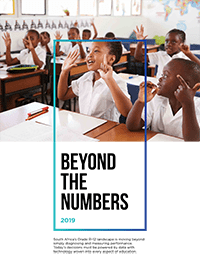
Last year, 20,000 South African high school students dressed neatly in their school uniforms marched for minimum norms and standards in education infrastructure. It was a public holiday and the students, part of an organisation called Equal Education, were largely unaccompanied by adults.
The march was a vivid illustration of a painful reality of education in South Africa today: Our country is one of supposed opportunity, but each year, the education system leaves behind literally thousands of children eager for change. In fact, education activists such as Mamphela Ramphele go so far as to argue that education in South Africa is now worse than under apartheid.
The role of chance
For the majority of South African children, receiving a quality education is neither a norm or a human right. It’s a rare opportunity based on luck. Most South African public schools remain dysfunctional and oversubscribed, while private schools are not affordable for the poor or the unemployed — a massive 25 percent of the South African population.
This unequal access to quality instruction is reflected in disparate student results: Although black students account for nearly 50 percent of all university students and 80 percent of the country’s population, less than one in 20 black students ends up with a post-high school qualification or degree compared to one in two white students.[1] It’s thus unsurprising that top university graduates are still overwhelmingly produced by a small number of schools, most of them historically white.
Perplexingly, this systemic weakness remains deeply rooted in spite of the fact that, by international standards, South Africa’s education system gets a comparatively large slice of the public funding pie. In fact, at about 5.3 percent of gross domestic product (GDP) and 20 percent of total state expenditure, education in South Africa is subsidized by one of the highest rates of public investment in education in the world. In addition to public investment there have also been significant charitable investments in reforming the public school system since the end of Apartheid (estimated most recently at $330M annually.[2]) In other words, we’re spending a lot of money to educate our children, and yet the vast majority are getting left by the wayside. Why? And what can we do about it?
Defining “quality”: The first step in the journey to systemic turn-around
Like other observers of education in South Africa, we know that systemic school turn-around will take many years. But we also believe that there’s reason for hope in the form of a handful of truly inspiring teachers and school leaders who are taking the earliest steps on a path that could point the way to a system that routinely provides the most marginalized children in South Africa with a quality education. The South African Extraordinary Schools Coalition, a group that the foundation has helped to foster, includes many of these reformers and is in the early stages of figuring out how to systematically tackle the problems that plague our nation’s schools.
Before coming together, educators and leaders of this small group, which includes 13 public and independent schools, had each been grappling in comparative isolation with the question of how to provide high quality education to disadvantaged students. Each has faced numerous challenges starting with finding, funding and retaining high-quality teachers. Each has struggled with the challenges of supporting students who come from poverty-stricken township environments, where crime and HIV/AIDS often dictate that survival takes priority over education. But in the face of long odds, each has shown that it can help students achieve well beyond their peers.
The coalition’s current focus is on articulating how and what each member does to help students, and then on translating that into a set of best practices and guidelines that will help schools nationwide raise their own quality — which sounds straightforward, but which (surprise!) has hidden challenges, one of the most fundamental of which is the simple definition of “quality education.” Coalition members have so far agreed that the final measure of success (i.e., quality) will be their high school graduates’ ability to get through university and on to employment. In other words, merely passing the matric, even at the bachelors pass level (a widely accepted measure of university readiness), is no longer sufficient.
The road ahead: Interim goals will lead to larger gains
Of course, the real key to ensuring that ultimate measure of success will be helping students master a series of interim goals throughout the years leading up to matric and university. Establishing those interim goals, let alone teaching students to master them, will require not only a lot of negotiation, but also a commitment to pragmatism, to ongoing evaluation of results, and to continually improving approaches that work while tossing out those that don’t.
As long and difficult as that process will doubtless be, we see concrete reasons for hope in the coalition’s deliberate approach and hands-on efforts to define measures of success and quality. And we believe that, if the larger community of stakeholders who care about access to quality education for all in South Africa has the will, it can ultimately springboard off the coalition’s work to ignite a true educational quality movement that has the potential to scale to reach millions of children and to remain sustainable over time.
Learn more about the foundation’s efforts to provide high-achieving but disadvantaged South African students with support to beat the odds through the Dell Young Leaders Scholarship Program.

2 comments